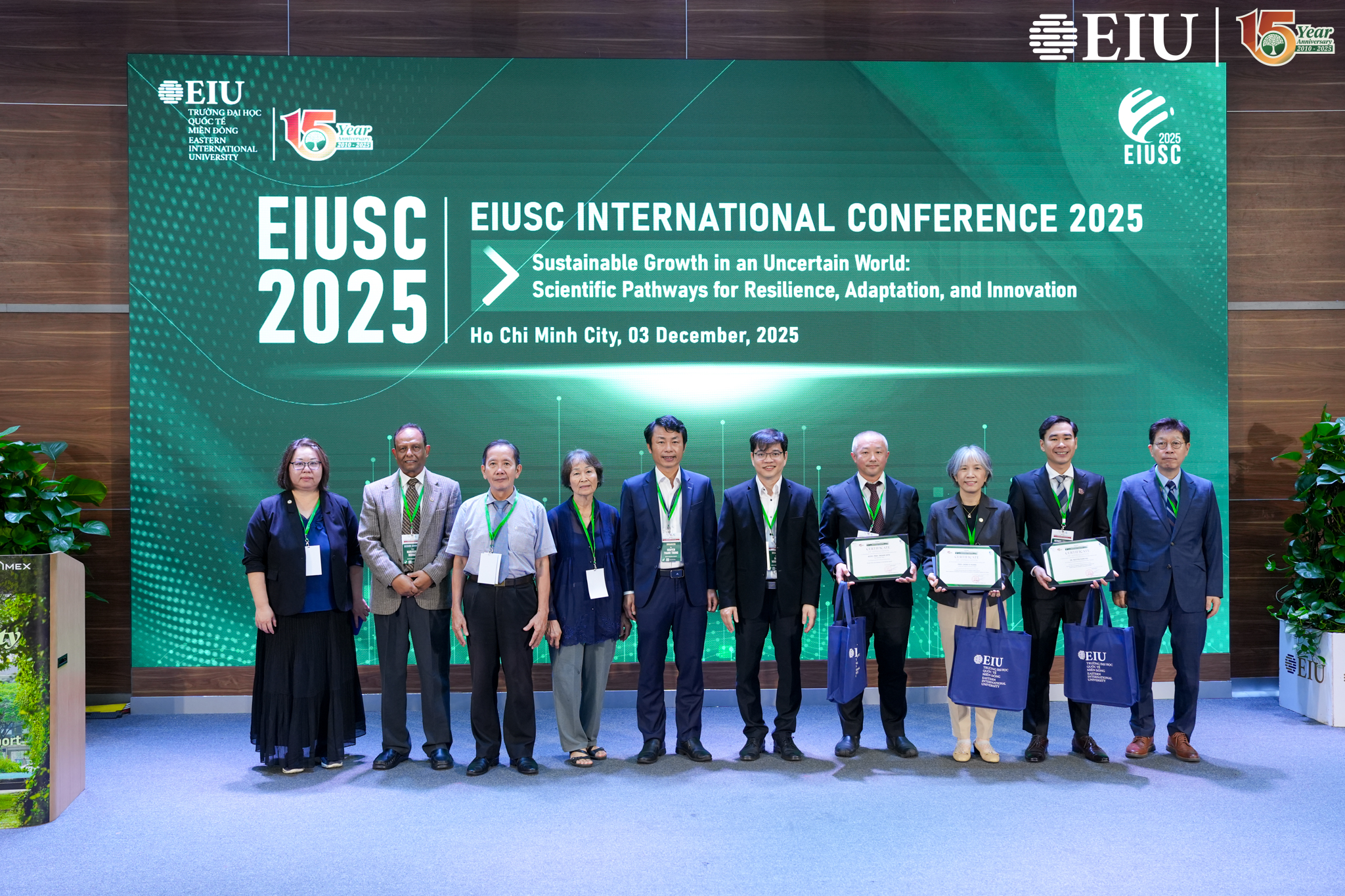

On December 3, the Eastern International University Scientific Conference 2025 (EIUSC 2025), themed “Sustainable Growth in an Uncertain World: Scientific Pathways for Resilience, Adaptation, and Innovation,” officially commenced.
EIUSC 2025 welcomed more than 320 researchers, lecturers, specialists, and students of the University, together with guests from partner universities including Toyo University, Chung Shan Medical University, and The University of Hong Kong.

Dr Ngo Minh Duc – President of EIU delivered his remarks at the conference
In his opening remarks, Dr. Ngo Minh Duc, President of the University, emphasized that scientific research has always played a pivotal role in the University’s development strategy. It not only expands the knowledge base and academic capacity of the institution but also drives the search for practical and innovative solutions to address pressing societal challenges. With the theme of EIUSC 2025, EIU aims to create a space where scientists and experts can exchange knowledge and discuss research findings across various fields, thereby fostering new initiatives and contributing solutions that support sustainable socio-economic development.
The Conference consists of three main sessions: the Plenary Session; Specialized Parallel Sessions; and the Poster Session, the latter of which took place on December 2. These sessions revolve around major thematic areas such as Economics, Business and Management; Engineering Symposium; Health Sciences Symposium and Information Technology Symposium and other related fields.

Assoc. Prof. Dr Takaaki Goto delivered a presentation titled “Current Status and Challenges in AI for Next Society”
During the plenary session, Assoc. Prof. Dr. Takaaki Goto from the Faculty of Information Science and Arts, Toyo University, delivered a presentation title “Current Status and Challenges in AI for Next Society.” He highlighted the crucial role and emerging challenges of AI in relation to sustainable development (SDGs). According to him, AI significantly supports various sectors such as the environment, agriculture, transportation, and healthcare, while simultaneously posing challenges concerning energy consumption and environmental impact. Therefore, Sustainable IT and Sustainable AI are becoming imperative, requiring solutions related to energy efficiency and renewable energy.

Prof Cheng-Yi Huang presented on “AI-Ready Nursing Education for Resilient Health Systems: How to integrate trustworthy AI into curricula and practice to strengthen readiness for shocks”
Continuing the program, Prof. Cheng-Yi Huang from the Department of Nursing, Chung Shan Medical University, presented on “AI-Ready Nursing Education for Resilient Health Systems: How to Integrate Trustworthy AI into Curricula and Practice to Strengthen Readiness for Shocks.” His discussion focused on preparing the nursing workforce for the era of AI amid continuous shocks to health systems, such as pandemics and workforce shortages. AI is considered a powerful tool for both healthcare delivery and nursing education; however, its rapid development also introduces significant challenges. To address this, he proposed a strategic framework with three directions: using AI to cultivate higher-order thinking; redesigning assessment toward interactive approaches where AI serves only as a starting point; and building an ethical foundation that fosters responsible AI use among learners.

Dr Nguyen Xuan Hai presented the talk “The Twin Pillars of Prosperity: Aligning Financial Stability and Human Capital for Vietnam’s Sustainable Growth”
Concluding the Plenary Session, Dr. Nguyen Xuan Hai – Deputy Director, Representative Office of The University of Hong Kong presented the talk “The Twin Pillars of Prosperity: Aligning Financial Stability and Human Capital for Vietnam’s Sustainable Growth.” He noted that to achieve the goal of becoming a high-income nation by 2045, Vietnam must overcome the middle-income trap by shifting from quantity-based growth to quality-driven development. Accordingly, he proposed a new development model built on two key pillars: a robust financial architecture and an innovative human capital base.


Authors delivered their presentations across the sessions
In the afternoon, during the specialized sessions, researchers, lecturers, and students presented their study results before the Review Committees. After each presentation, the Committees provided in-depth comments and feedback to clarify arguments, methodologies, and research significance. This two-way academic exchange fostered a dynamic and intellectually rich atmosphere throughout the Conference.


EIU presented certificates to authors whose papers and posters received awards.
At the conclusion of the Conference, the Organizing Committee presented certificates and awards to 10 outstanding oral presentations, 8 excellent posters, and 1 consolation work. The qualified studies will continue to be selected for publication in the Conference’s full proceedings (with ISBN). In particular, high-quality papers will be recommended for publication in reputable scientific journals./.
Some images at the conference: