
Program
Computer networks and Data communications
Program code
7480102
Length of time
4 years
Education level
Undergraduate
Mode of Study
Full-time
Languages
Vietnamese and English
INTRODUCTION
4 years
180 credits (quarter system – 3 quarters/year)
VND 30.000.000/year*
*Tuition fees are guaranteed not to increase for four years from the date of enrollment
The Bachelor of Computer Networks and Data Communications programme provides students with up-to-date knowledge and skills in Information and Communication Technology (ICT) to address technical challenges in the digital era. The program focuses on designing, developing, and managing computer network systems; detecting and preventing cyberattacks; ensuring network security and information safety; and developing and managing Wireless Sensor Networks (WSNs) and Internet of Things (IoT) systems. Students benefit from a combination of theoretical learning, hands-on practice, and real-world industry experience. Specialized courses further enhance their abilities to analyze and evaluate network performance and security, as well as explore emerging technologies and research topics. Graduates are well-prepared to pursue careers and research opportunities in both domestic and international environments.
The Bachelor of Computer Networks and Data Communications program offers three concentrations:
- Concentration in Computer Networks and Systems Administration: Focuses on analyzing, designing, deploying, and managing network infrastructure, server systems, and data storage systems, as well as implementing software applications for domestic and international organizations.
- Concentration in Cyber Security: Focuses on analyzing, detecting, and preventing cyberattacks; implementing security solutions; developing information security policies; assessing security risks; and monitoring network systems to ensure network security and information safety.
- Concentration in Internet of Things (IoT): Focuses on designing, developing, deploying, and managing IoT systems, integrating devices, sensors, and network connectivity, and developing IoT applications for practical applications.
about School of Computing and Information Teachnology
School of Computing and Information Technology was established with a mission to provide high quality human resources for industrial development not only in area but also for key economic regions.
Program Highlights
100% of students will achieve at least IELTS band 6.0 before graduation.
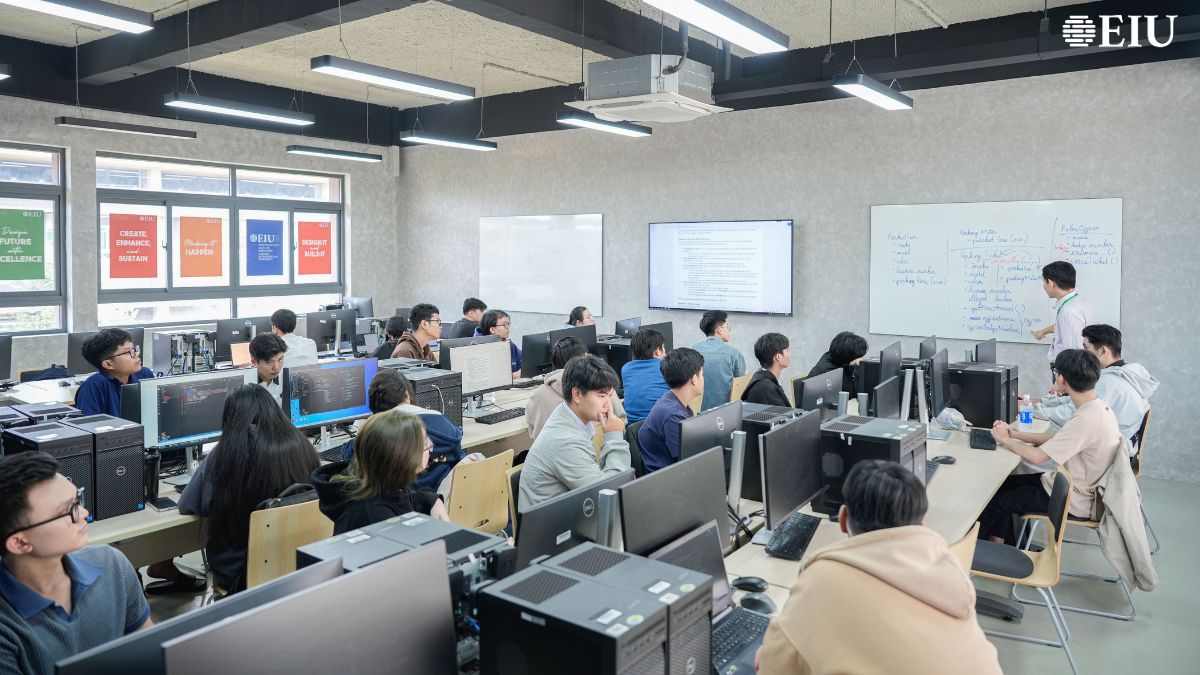
Students will study in a modern environment, with a system of modern practice rooms that meet the requirements of study and research. Furthermore, practice hours account for more than 40%.
Students will have many opportunities to work with faculty members on creative projects, do academic research, and participate in national and international conferences.
Students are facilitated to study and practice at major domestic and international companies starting from the third year.
Program learning outcomes
Upon completion of the program, students must meet the following minimum requirements:
Knowledge
- PLO1: Apply knowledge of political theory and social sciences, as well as legal understanding, to life and professional practice; understand national defence and security to promote patriotism; apply knowledge of physical self-training to improve personal health.
- PLO2: Apply fundamental knowledge of natural sciences and foundation knowledge of the discipline to solve technical problems; analyse and solve problems related to the field of CNDC.
- PLO3: Design, implement, and evaluate discipline-related solutions to meet the requirements of the discipline.
Skill
- PLO4:Communicate effectively at work.
- PLO5:Have the ability to work effectively as a member or leader of a team performing discipline-related tasks.
- PLO6:Effectively use modern equipment of the discipline and software tools necessary for the discipline.
Autonomy & Responsibilities
- PLO7:Assume individual responsibility and collective responsibility, maintain a sense of community service, and uphold professional ethics.
- PLO8: Engage in self-study and research to develop professional skills and entrepreneurial capacity in the field of ICT.
Academic program
facilities
Students can practice at the following labs and centers:
The modern computer labs.
The Artificial Intelligence Research Center.
The Cybersecurity Center of the University in collaboration with ARIS Company – Japan.
Study Environment
Job Opportunities
Graduates of the Computer Networks and Data Communications programme can take on various positions, such as:
- Computer network system administrator: deploying and managing network infrastructure, server systems, data storage, and software applications for domestic and international companies.
- Network security and information security specialist: detecting and preventing cyberattacks, implementing security measures, and providing consultancy on security policies; developing information security policies, testing and assessing security risks, and monitoring systems to detect potential threats.
- Specialist in the field of Internet of Things (IoTs): developing, deploying, and managing IoT systems, including designing IoT devices, connecting and integrating sensors, and developing IoT applications.
- Specialist in researching and applying new communication technology solutions for companies, colleges, and universities in Vietnam and abroad.
- Lecturer in the field of Information and Communication Technology; Department head or leader of IT projects in domestic and international companies and corporations.
- Students can continue with post-graduate degrees in Vietnam and other countries, or they can establish their own business in computer networks and data communications engineering.